
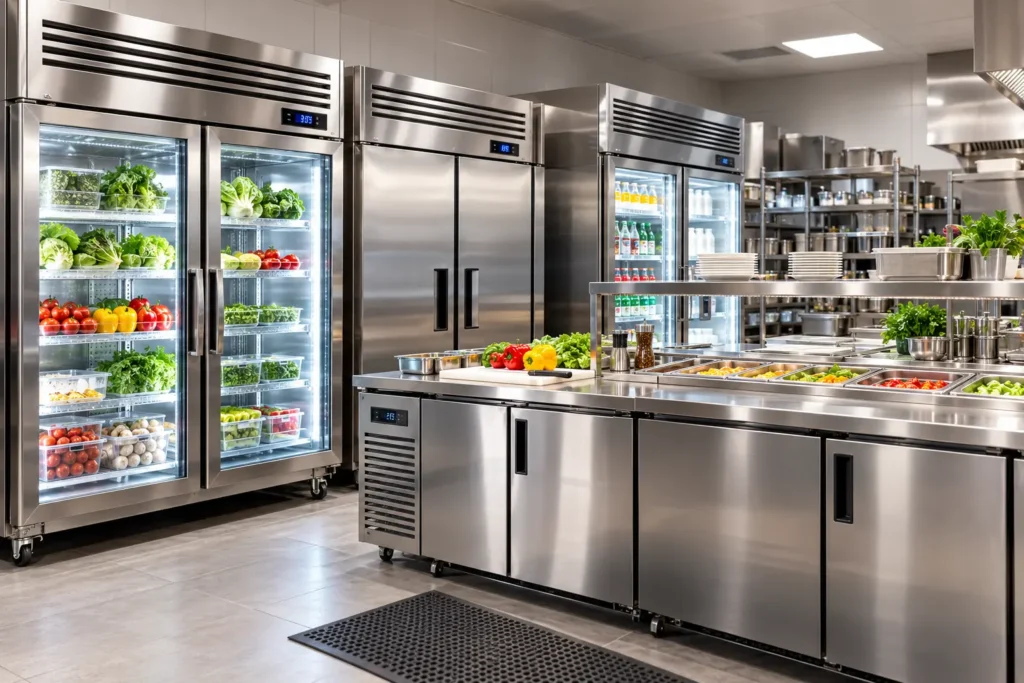
It protects food quality, supports safe storage, reduces waste, and helps kitchen staff work efficiently
during busy service periods.
Choosing the right refrigerator or freezer is not only about cabinet size.
Buyers also need to consider storage temperature, kitchen ambient temperature, door configuration,
compressor performance, energy consumption, available floor space, voltage, and daily operating volume.
For restaurant owners, distributors, contractors, and commercial kitchen project buyers,
understanding the main types of commercial refrigeration equipment can help avoid
undersized systems, poor workflow, and unnecessary operating costs.
If you are planning a restaurant, hotel kitchen, bakery, catering facility, or central kitchen,
you can also review Weilibao’s
commercial kitchen equipment range
as part of your overall project planning.
What Is Commercial Refrigeration Equipment?
Commercial refrigeration equipment is designed to store, chill, freeze, display,
or prepare food and beverages in professional food-service environments.
Compared with residential refrigerators, commercial units are generally built for
more frequent door opening, higher storage loads, longer operating hours,
and more demanding kitchen conditions.
A typical restaurant refrigeration equipment list may include:
- Upright refrigerators
- Upright freezers
- Undercounter refrigerators
- Undercounter freezers
- Refrigerated preparation counters
- Display refrigerators
- Display freezers
- Beverage coolers
- Worktop refrigerators
- Cold storage cabinets
The correct combination depends on your menu, storage volume, available kitchen space,
service speed, and local operating conditions.
Upright Commercial Refrigerators
Upright refrigerators are commonly used for storing fresh ingredients, prepared foods,
dairy products, beverages, sauces, and other refrigerated items.
Their vertical design provides high storage capacity without requiring excessive floor space,
making them suitable for many restaurant, hotel, bakery, and catering kitchens.
Single-Door Refrigerators
Single-door refrigerators are useful for smaller kitchens, lower storage volumes,
or dedicated storage of a specific ingredient category.
Two-Door Refrigerators
Two-door models provide larger storage capacity and can help separate ingredients
into different storage zones.
Three-Door Refrigerators
Three-door refrigerators are better suited to high-volume kitchens where large quantities
of chilled ingredients need to be accessed throughout the day.
When selecting an upright commercial refrigerator, check:
- Gross and usable storage volume
- Number of doors
- Shelf configuration
- Temperature range
- Cooling method
- Compressor specification
- Ambient temperature rating
- Voltage and frequency
Commercial Freezers
Commercial freezers are used for frozen meat, seafood, prepared foods,
desserts, bakery ingredients, and other products requiring long-term frozen storage.
Freezer capacity should be based on actual inventory requirements rather than purchasing
the largest available cabinet.
Upright Freezers
Upright freezers offer convenient access and organized shelf storage,
making them suitable for busy kitchens where frozen ingredients are used throughout service.
Undercounter Freezers
Undercounter freezers are useful when frozen ingredients need to be stored
close to a cooking or preparation station.
Display Freezers
Display freezers are designed for customer-facing environments where frozen products
need to remain visible while maintaining the required storage temperature.
Important freezer specifications include:
- Operating temperature range
- Defrost system
- Insulation thickness
- Door sealing
- Recovery time after door opening
- Compressor capacity
- Ambient operating temperature
Undercounter Refrigeration Equipment
Undercounter refrigeration combines cold storage with a compact footprint,
allowing ingredients to be stored directly below a preparation or cooking area.
This configuration is especially useful in kitchens where workflow speed
and space efficiency are important.
Typical applications include:
- Pizza preparation stations
- Sandwich preparation areas
- Cooking lines
- Bar counters
- Café preparation areas
- Hotel service kitchens
Before selecting an undercounter refrigerator, confirm the installation space,
ventilation clearance, worktop height, door or drawer configuration,
and required storage capacity.
Refrigerated Prep Tables
Refrigerated preparation tables combine chilled storage with a work surface,
helping staff keep frequently used ingredients close to the preparation station.
These units are commonly used for:
- Pizza preparation
- Sandwich preparation
- Salad preparation
- Cold food assembly
- Bakery ingredient storage
Buyers should pay attention to pan configuration, worktop depth, internal storage volume,
temperature consistency, cleaning access, and refrigeration airflow.
Commercial Display Refrigeration
Display refrigeration is designed to keep chilled products visible to customers
while maintaining a controlled temperature.
Common applications include:
- Bakery display cases
- Deli counters
- Beverage refrigerators
- Cake display cabinets
- Grab-and-go refrigeration
- Supermarket-style chilled displays
Glass Door Refrigerators
Glass door refrigerators allow staff or customers to see products without opening the door,
which can improve product visibility and reduce unnecessary door opening.
Open Display Refrigerators
Open display units provide faster product access but require careful consideration
of ambient temperature, airflow, and energy consumption.
Bakery Display Refrigerators
Bakery display refrigerators are commonly used for cakes, desserts, pastries,
and chilled bakery products where both temperature control and product presentation matter.
How Commercial Refrigeration Systems Work
Commercial refrigeration equipment removes heat from the cabinet and transfers it
through a refrigeration system that typically includes a compressor, condenser,
evaporator, refrigerant, and temperature control system.
Compressor
The compressor circulates refrigerant through the system and is one of the most important
components affecting cooling performance and reliability.
Condenser
The condenser releases heat from the refrigeration system.
Adequate ventilation around the condenser is important for efficient operation.
Evaporator
The evaporator absorbs heat from inside the cabinet and helps maintain the required storage temperature.
Temperature Controller
The controller monitors cabinet temperature and regulates refrigeration operation
according to the selected set point.
Fan Cooling vs Static Cooling
One important decision when selecting commercial refrigeration equipment is the cooling method.
Fan Cooling
Fan-cooled systems circulate cold air throughout the cabinet,
helping maintain more even temperatures across multiple shelves.
They are commonly used in professional kitchens where doors are opened frequently
and rapid temperature recovery is important.
Static Cooling
Static cooling relies more heavily on natural air circulation.
It can be suitable for certain applications but may create larger temperature differences
between different areas of the cabinet.
The best option depends on the stored product, cabinet design, operating conditions,
and required temperature consistency.
Commercial Refrigeration Temperature Requirements
The required storage temperature depends on the type of food being stored
and applicable local food-safety regulations.
As a general purchasing principle, buyers should confirm:
- Required chilled storage range
- Required frozen storage range
- Product sensitivity to temperature fluctuation
- Frequency of door opening
- Expected ambient kitchen temperature
- Temperature recovery performance
Final operating temperatures should always be set according to the food product
and local food-safety requirements.
Why Ambient Kitchen Temperature Matters
Ambient temperature is one of the most important but often overlooked factors
when choosing commercial refrigeration equipment.
A refrigerator operating in an air-conditioned café may face very different conditions
from the same unit installed beside fryers, ovens, and cooking ranges in a hot restaurant kitchen.
High ambient temperatures can increase:
- Compressor workload
- Energy consumption
- Temperature recovery time
- System operating pressure
- Component wear
Buyers should therefore confirm the expected kitchen temperature before selecting the refrigeration system.
Energy Efficiency in Commercial Refrigeration Equipment
Refrigeration equipment often operates 24 hours a day, making energy efficiency
an important part of total operating cost.
Factors that can influence energy consumption include:
- Compressor efficiency
- Insulation quality
- Door gasket condition
- Door opening frequency
- Cabinet loading
- Ambient temperature
- Condenser cleanliness
- Temperature set point
A lower purchase price does not always mean lower total cost of ownership.
Energy consumption, maintenance, spare parts, and expected service life should also be considered.
Commercial Refrigeration Equipment Comparison
The following table provides a quick overview of common commercial refrigeration formats.
| Equipment Type | Typical Use | Main Buying Consideration |
|---|---|---|
| Upright Refrigerator | General chilled food storage | Capacity, doors, temperature range |
| Upright Freezer | Frozen ingredient storage | Freezing performance, insulation |
| Undercounter Refrigerator | Cooking or preparation stations | Size, access, ventilation |
| Prep Table | Pizza, salad, sandwich preparation | Pan layout, storage capacity |
| Display Refrigerator | Customer-facing product display | Visibility, temperature, energy use |
| Beverage Cooler | Drinks and packaged beverages | Door type, display, capacity |
How to Choose Commercial Refrigeration Equipment
Calculate Required Storage Capacity
Start by estimating how much chilled and frozen inventory must be stored
during your busiest operating period.
Consider Kitchen Workflow
Refrigeration should be positioned where staff can access ingredients
without unnecessary walking or interference with other workstations.
Confirm Installation Dimensions
Measure cabinet space, doorways, access routes, ventilation clearance,
and service clearance before ordering.
Confirm Voltage and Frequency
International buyers should confirm voltage, frequency, phase,
plug requirements, and rated power before production.
Confirm Ambient Temperature
Tell the supplier where and how the equipment will be used,
especially if it will operate in a hot commercial kitchen.
Check Cleaning and Maintenance Access
Condensers, filters, drain systems, shelves, door gaskets,
and internal surfaces should be accessible for regular cleaning and maintenance.
Commercial Refrigeration Equipment by Business Type
Restaurant
- Upright refrigerator
- Upright freezer
- Undercounter refrigerator
- Preparation counter
Bakery
- Ingredient refrigerator
- Bakery display refrigerator
- Freezer
- Refrigerated preparation table
Café
- Beverage cooler
- Undercounter refrigerator
- Display refrigerator
- Small freezer
Hotel Kitchen
- Large upright refrigerators
- Commercial freezers
- Prep counters
- Undercounter refrigeration
- Display refrigeration
Central Kitchen
- High-capacity refrigerated storage
- Freezer storage
- Refrigerated workstations
- Preparation refrigeration
What to Ask a Commercial Refrigeration Equipment Supplier
What Temperature Range Can the Unit Maintain?
Confirm the operating temperature range and whether it is suitable for the intended food products.
What Ambient Temperature Is the Unit Designed For?
This is especially important for equipment installed in hot restaurant kitchens.
What Compressor Is Used?
Ask about compressor specifications, availability of replacement parts,
and the refrigeration system configuration.
Can Voltage and Frequency Be Customized?
Confirm electrical requirements before production for international projects.
What Refrigerant Is Used?
Refrigerant requirements can differ by destination market,
so the refrigerant type should be confirmed before ordering.
Are Spare Parts Available?
Ask about controllers, fans, door gaskets, compressors,
and other commonly serviced components.
Can the Cabinet Size or Configuration Be Customized?
This can be important for project kitchens where equipment must fit a specific layout.
Send us your required refrigerator or freezer type, dimensions, storage capacity,
voltage, destination market, and expected kitchen conditions.
Our team can review the specification before quotation.
Choose upright, undercounter, prep or display formats.
Confirm temperature, voltage, capacity and operating conditions.
Match refrigeration equipment to the overall kitchen layout.
Frequently Asked Questions
What is commercial refrigeration equipment?
Commercial refrigeration equipment includes refrigerators, freezers,
refrigerated prep counters, display cabinets, beverage coolers,
and other systems designed for professional food-service storage and display.
What refrigeration equipment does a restaurant need?
Most restaurants use a combination of upright refrigerators,
freezers, undercounter refrigeration, and refrigerated preparation equipment.
The exact combination depends on the menu and daily storage volume.
What should I look for when buying a commercial refrigerator?
Important factors include storage capacity, temperature range,
ambient temperature rating, compressor performance, cooling method,
door configuration, energy consumption, voltage, and installation space.
What is the difference between commercial and residential refrigeration?
Commercial refrigeration is generally designed for longer operating hours,
more frequent door opening, heavier storage loads, and professional kitchen conditions.
Why is ambient temperature important for commercial refrigeration?
High ambient temperatures increase the cooling load on the refrigeration system
and can affect energy consumption, recovery time, and component life.
Can commercial refrigeration equipment be customized for different voltages?
Many commercial refrigeration manufacturers can adapt equipment for different
voltage, frequency, phase, and plug requirements.
These specifications should be confirmed before production.