
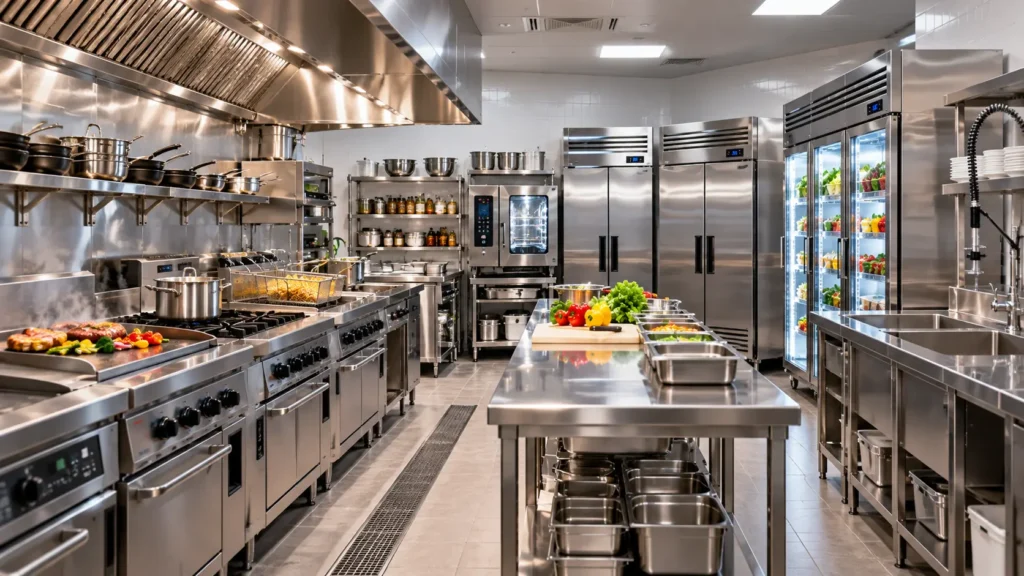
A complete restaurant kitchen equipment list should be built around
the menu, expected production volume, available space, workflow, utility connections,
and local food-service requirements.
Buying equipment without planning these factors first can lead to oversized machines,
insufficient refrigeration, inefficient staff movement, power supply problems,
and unnecessary investment.
For restaurant owners, distributors, contractors, and commercial kitchen project buyers,
this guide provides a practical overview of the essential equipment commonly used
in professional restaurant kitchens.
You can also explore Weilibao’s
commercial restaurant and kitchen equipment
when preparing your equipment list.
What Equipment Does a Restaurant Kitchen Need?
Most restaurant kitchens require equipment from several core categories.
The exact configuration depends on the restaurant concept, menu, kitchen size,
and service volume.
A typical restaurant equipment list includes:
- Commercial cooking equipment
- Commercial refrigeration equipment
- Food preparation equipment
- Stainless steel worktables and sinks
- Dishwashing and cleaning equipment
- Food holding equipment
- Storage equipment
- Ventilation equipment
- Smallwares and supporting equipment
The goal is not simply to buy every available machine.
Each item should support a specific function in the restaurant’s production flow.
Commercial Cooking Equipment
Cooking equipment usually forms the center of the hot kitchen.
Your menu should determine which machines are required and how much capacity is needed.
Common restaurant cooking equipment includes:
- Commercial ranges
- Gas ranges
- Electric ranges
- Commercial ovens
- Convection ovens
- Fryers
- Griddles
- Charbroilers
- Salamanders
- Steamers
- Stock pot ranges
- Pasta cookers
- Rice cookers
- Food warmers
Commercial Ranges
Commercial ranges are commonly used for boiling, frying, simmering,
sautéing, and other general cooking tasks.
Buyers should confirm burner quantity, heating power, gas type,
construction material, and overall dimensions.
Commercial Ovens
Ovens may be required for roasting, baking, reheating, and batch cooking.
Common formats include convection ovens, deck ovens, and specialized bakery ovens.
Commercial Fryers
Fryers are essential in many fast-food restaurants, cafés,
casual dining kitchens, and catering operations.
Important considerations include oil capacity, heating power,
recovery speed, number of tanks, and gas or electric configuration.
Griddles and Charbroilers
Griddles are commonly used for burgers, eggs, vegetables, pancakes,
and other flat-surface cooking applications.
Charbroilers are more suitable for foods requiring direct high-temperature grilling.
Commercial Refrigeration Equipment
Refrigeration is critical for food safety, ingredient storage,
inventory management, and kitchen workflow.
Typical restaurant refrigeration equipment includes:
- Upright refrigerators
- Upright freezers
- Undercounter refrigerators
- Undercounter freezers
- Refrigerated prep counters
- Worktop refrigerators
- Display refrigerators
- Beverage coolers
Upright Refrigerators
Upright refrigerators provide high storage capacity while using relatively little floor space.
They are commonly used for fresh ingredients, dairy products, sauces, prepared foods,
and beverages.
Undercounter Refrigerators
Undercounter models are useful on preparation and cooking lines
because ingredients can be stored directly below the workstation.
Commercial Freezers
Freezers are used for meat, seafood, frozen foods, desserts,
bakery ingredients, and longer-term inventory storage.
For a more detailed comparison, see our
commercial refrigeration equipment guide
.
Food Preparation Equipment
Preparation equipment helps reduce manual labor,
improve consistency, and increase output during busy service periods.
Common food preparation equipment includes:
- Food processors
- Vegetable cutters
- Meat slicers
- Meat grinders
- Bone saws
- Planetary mixers
- Dough mixers
- Blenders
- Potato peelers
Choose Capacity Based on Production Volume
Equipment capacity should be matched to actual production requirements.
A machine suitable for a small café may become a bottleneck in a high-volume restaurant.
Consider Cleaning and Maintenance
Food preparation equipment should be easy to disassemble,
clean, inspect, and maintain.
Replacement blades, belts, motors, switches, and other service parts
should also be considered before purchase.
Stainless Steel Kitchen Equipment
Stainless steel equipment provides the work surfaces,
washing areas, shelving, and supporting infrastructure of a restaurant kitchen.
Typical stainless steel equipment includes:
- Work tables
- Preparation tables
- Single-bowl sinks
- Double-bowl sinks
- Three-compartment sinks
- Wall shelves
- Storage cabinets
- Dish tables
- Stainless steel racks
- Trolleys
Worktables
Worktables provide hygienic surfaces for preparation, plating,
equipment placement, and general kitchen operations.
Sinks
Different sink configurations may be required for food preparation,
hand washing, pot washing, or dishwashing.
304 vs 201 Stainless Steel
304 stainless steel generally offers stronger corrosion resistance
and is commonly preferred for demanding food-service environments.
201 stainless steel can be more cost-effective in certain applications,
particularly in drier environments.
Dishwashing and Cleaning Equipment
Efficient washing and sanitation are essential to restaurant operations.
Dishwashing capacity should be matched to peak-hour service volume.
Typical equipment includes:
- Commercial dishwashers
- Glass washers
- Pot washing sinks
- Three-compartment sinks
- Pre-rinse units
- Dish tables
- Hand-wash sinks
- Waste bins
Buyers should confirm water supply, hot water requirements,
drainage, electrical power, and available installation space.
Food Holding and Warming Equipment
Food holding equipment helps maintain prepared dishes at suitable serving temperatures
between cooking and service.
Common equipment includes:
- Food warmers
- Hot holding cabinets
- Bain maries
- Heat lamps
- Soup warmers
- Buffet warmers
Holding equipment is especially important for buffets,
hotels, catering kitchens, fast-food operations, and high-volume restaurants.
Restaurant Kitchen Storage Equipment
Good storage design reduces clutter, improves inventory organization,
and helps staff work more efficiently.
Common storage equipment includes:
- Stainless steel shelving
- Wall-mounted shelves
- Storage cabinets
- Ingredient bins
- Mobile racks
- Dry storage racks
- Utility carts
Separate Food and Cleaning Storage
Cleaning chemicals and maintenance products should be stored separately
from ingredients and food-contact items.
Use Vertical Space Efficiently
Wall shelves and rack systems can increase usable storage capacity
without consuming additional floor space.
Commercial Kitchen Ventilation Equipment
Cooking equipment can produce heat, steam, smoke, grease,
and combustion gases that need to be managed through an appropriate ventilation system.
Restaurant ventilation may include:
- Exhaust hoods
- Grease filters
- Exhaust fans
- Fresh-air systems
- Ductwork
Ventilation requirements depend on the cooking equipment,
kitchen layout, local regulations, and building conditions.
These requirements should be confirmed during the kitchen planning stage,
not after the cooking equipment has already been installed.
Smallwares and Supporting Equipment
Large equipment forms the foundation of a restaurant kitchen,
but smallwares are required for daily food preparation and service.
Typical smallwares include:
- Cookware
- Knives
- Cutting boards
- Mixing bowls
- Food storage containers
- Utensils
- Trays
- Measuring tools
- Thermometers
These items are usually selected according to menu requirements
and operating procedures rather than kitchen size alone.
Restaurant Kitchen Equipment List at a Glance
The following table summarizes the main equipment categories
used in a typical commercial restaurant kitchen.
| Category | Typical Equipment | Main Purpose |
|---|---|---|
| Cooking | Range, oven, fryer, griddle, steamer | Cooking and heat processing |
| Refrigeration | Refrigerator, freezer, prep counter | Chilled and frozen storage |
| Preparation | Slicer, processor, mixer, grinder | Ingredient preparation |
| Stainless Steel | Worktable, sink, shelf, cabinet | Preparation, washing and storage |
| Dishwashing | Dishwasher, sink, pre-rinse unit | Cleaning and sanitation |
| Holding | Food warmer, hot cabinet, bain marie | Maintain serving temperature |
| Storage | Rack, cabinet, shelving | Ingredient and equipment organization |
| Ventilation | Hood, exhaust fan, ductwork | Remove heat, smoke and grease |
Restaurant Kitchen Equipment List by Restaurant Type
Different restaurant concepts require different equipment combinations.
The following examples provide a useful starting point.
Fast Food Restaurant
- Commercial fryers
- Griddles
- Holding cabinets
- Food warmers
- Undercounter refrigerators
- Freezers
- Prep tables
- Sinks
Full-Service Restaurant
- Commercial range
- Convection oven
- Fryer
- Griddle
- Upright refrigerator
- Freezer
- Food preparation equipment
- Dishwasher
- Stainless steel worktables
Café
- Undercounter refrigerator
- Display refrigerator
- Small oven
- Blender
- Preparation table
- Sink
- Storage shelving
Bakery
- Deck oven
- Convection oven
- Dough mixer
- Planetary mixer
- Dough sheeter
- Proofer
- Bakery refrigerator
- Stainless steel worktables
Hotel Restaurant
- Commercial ranges
- Multiple ovens
- Refrigeration equipment
- Bakery equipment
- Buffet equipment
- Dishwashing systems
- Stainless steel fabrication
- Storage systems
How to Build the Right Restaurant Equipment List
Start With the Menu
Every piece of equipment should support a specific menu item,
preparation process, storage requirement, or service function.
Estimate Daily Production
Calculate expected meals per day, peak-hour orders,
batch sizes, preparation volume, and storage requirements.
Plan the Kitchen Workflow
Equipment should follow the natural movement of food through the kitchen:
receiving, storage, preparation, cooking, plating, service, washing, and waste handling.
Measure Available Space
Confirm:
- Kitchen dimensions
- Doorways
- Columns
- Drainage points
- Electrical points
- Gas connections
- Ventilation locations
Confirm Utility Requirements
Before production, confirm voltage, frequency, phase,
plug type, gas type, water supply, drainage, and ventilation requirements.
What Specifications Should Buyers Confirm Before Ordering?
Once the equipment list is complete, each machine should be checked
against the project’s technical and commercial requirements.
Important specifications include:
- Model and equipment type
- Overall dimensions
- Capacity
- Power rating
- Voltage
- Frequency
- Phase
- Gas type
- Water connection
- Drainage requirements
- Material specification
- Certification requirements
Confirming these details before production can prevent expensive modifications
after the equipment reaches the destination market.
What to Ask a Restaurant Kitchen Equipment Supplier
Can the Equipment Be Customized for Local Voltage?
International buyers should confirm voltage, frequency,
phase, and plug requirements before production.
What Certifications Are Available?
Certification requirements should be checked according to the destination market
and specific project.
Can Stainless Steel Dimensions Be Customized?
Custom worktables, sinks, shelves, and cabinets may help improve
kitchen space utilization.
Can Different Equipment Categories Be Supplied Together?
Purchasing cooking, refrigeration, stainless steel,
bakery, and supporting equipment together can simplify project coordination.
What Is the Production Lead Time?
Ask separately about stock models, standard production,
and customized products.
Are Spare Parts Available?
Spare-parts availability is especially important for international projects
where local service options may be limited.
Can You Review a Kitchen Layout or Equipment List?
For larger projects, supplier feedback can help identify capacity,
utility, and layout conflicts before production.
Restaurant Equipment Planning Checklist
Before placing an order, review the following project information:
- Final menu
- Expected meals per day
- Peak service volume
- Kitchen floor plan
- Equipment dimensions
- Cooking method
- Refrigeration capacity
- Voltage and frequency
- Gas requirements
- Water and drainage points
- Ventilation requirements
- Destination market
- Required certifications
For a broader project overview, you can also read our
complete commercial kitchen equipment checklist
.
Send us your menu, equipment list, kitchen dimensions, CAD drawing,
expected production volume, or reference project.
Our team can help review the equipment specifications before quotation.
Match cooking, refrigeration and preparation equipment to your menu.
Confirm voltage, gas, water, drainage and installation requirements.
Review equipment sizes and workflow before production.
Frequently Asked Questions
What equipment is needed for a restaurant kitchen?
Most restaurant kitchens need cooking equipment, refrigeration,
food preparation equipment, stainless steel worktables and sinks,
dishwashing equipment, storage, food holding equipment,
and appropriate ventilation.
What is the most important equipment in a restaurant kitchen?
The most important equipment depends on the menu.
Cooking equipment, refrigeration, preparation equipment,
washing facilities, and stainless steel work areas are common
to most commercial restaurant kitchens.
How do I make a restaurant kitchen equipment list?
Start with the menu, identify each preparation and cooking process,
estimate daily production, calculate storage needs,
and then match equipment capacity to the available kitchen space and utilities.
How much equipment does a small restaurant need?
A small restaurant may require fewer machines,
but it still needs adequate cooking, refrigeration, preparation,
washing, and storage capacity for its menu and service volume.
Should I choose gas or electric restaurant equipment?
The choice depends on the menu, local utility availability,
installation cost, energy pricing, ventilation,
and the type of cooking equipment required.
Can restaurant kitchen equipment be customized?
Many commercial kitchen equipment manufacturers can customize
voltage, frequency, plug type, stainless steel dimensions,
branding, and certain equipment configurations.
Requirements should be confirmed before production.